detailed Sydney trike tour – Mr + Mrs M 18.11.26
 Troll Tours Pty Ltd
The detailed Sydney trike tour took 2.5 hrs and our passengers sure saw a lot! Originally booked for two days ago, the weather was terrible so we changed it to today. We picked them up from their hotel in the Sydney CBD.
Sydney Harbour Bridge
Firstly, they rode over the Sydney Harbour Bridge. We always tell our passengers to look up and enjoy the unique view. The more than 6,000,000 rivets are so interesting and the arch is so iconic. It’s nicknamed ‘The Coathanger’ because of its arch-based design. It is the largest steel arch bridge in the world. This bridge is the eighth longest spanning-arch bridge in the world and the tallest steel arch bridge, measuring 134 m (440 ft) from top to water level. It was also the world’s widest long-span bridge, at 48.8 m (160 ft) wide, until a bridge in Canada was completed in 2012.
McMahons Point / Blues Point Reserve
Next, they rode on through Milsons Point, did a left hand turn and rode up a few streets. This leads to Blues Point Reserve. The views over Blues Bay towards the Sydney Opera House, the Harbour Bridge and the CBD are just stunning. The detailed Sydney trike tour, has shown our passengers some major Sydney icons already.
Kirribilli
Heading east, the rider took them through the back streets and into Kirribilli, to the Prime Minister‘s residence and Admiralty House. Kirribilli House is the secondary official residence of the Prime Minister of Australia.
Next door is Admiralty House. It is the Sydney residence of the Governor-General and one of the most historic and important residences on Sydney Harbour. The house – originally called ‘Wotonga’ – was built in the mid 1800’s.
After that, they rode around the corner to Jeffrey Street Wharf. From here, the views across Sydney Harbour towards the Sydney Opera House and the CBD are magnificent. In addition, it also has an up-close view of the side and underneath of the bridge. What a great view of the Sydney Opera House and Harbour Bridge!
The Kirribilli Loop – Harbour Bridge north side
From there, they rode under the north side of the bridge and continued on their tour. The underside of the northern end of the SHB – Sydney Harbour Bridge – is very interesting. The Kirribilli Loop was finished by riding past Luna Park and the North Sydney Olympic Pool. The detailed Sydney trike tour is sure showing the icons! Then it was back over the SHB.
Jacaranda trees
Not far from the northern end of the Bridge, is McDougall Street, Kirribilli. One of the most beautiful streets in Sydney with canopies of jacaranda trees. For six or so weeks (usually from mid-October before a peak in mid-November) the streets become filled with beautiful purple flowers gently falling on the footpaths like purple rain… it’s just stunning (ellaslist).
The funny thing about many tourists, is they jump out into the middle of the road. Not to take photos of the jacarandas but of the trike 😂 :-). Then it was back over the Sydney Harbour Bridge.
Sydney Opera House
A detour, they rode through Circular Quay and around the roundabout at the Opera House then up Macquarie Street so the passengers could see what the Light Rail looked like, they were going to use them over the next few days.
Designed by the Danish architect Jørn Utzon, the Sydney Opera House is a World Heritage-listed masterpiece and represents a breakthrough in modern architecture. The famous sails have become a symbol of Sydney and modern Australia as a whole.
When the Opera House opened its doors in 1973, a new era of cultural discovery began.
Conservatorium of Music
Past the Conservatorium of Sydney. Designed by Francis Greenway as stables for the Government House that had been commissioned by Governor Macquarie in 1816, the building became the Conservatorium in 1916. It’s a magnificent building and we have seen many a performance there. Ordinarily, unless on the detailed Sydney trike tour, or one of ou other tours, you probably wouldn’t think to check this amazing building out.
Macquarie Street
After finishing that loop road, they rode down Macquarie St. This street, is the location of the main governmental institutions of NSW: Parliament House, Government House, and the Law Courts Building (which houses the Supreme Court of New South Wales). There is so much history behind Macquarie St. and the buildings that front it.
In the years since its founding in 1788, Sydney had developed organically, and by the early 1800s was lacking in major public buildings, and had a complex network of narrow streets. The supply of drinking water and waste management was also becoming an issue. Governor Macquarie initiated the construction of Sydney’s first public buildings of any real permanence and set the boundaries of Sydney’s grid of streets, laying out the street in 1810.
Mitchell Library
Next, it was past the Mitchell Library. The Australian Subscription Library, established in 1826, was renamed as the Australian Library and Literary Institution in 1853. In 1869 the NSW Government purchased the collection and building to form the Sydney Free Public Library, the first truly public library for the people of NSW. Free Public Library was renamed in 1895 as the Public Library of NSW. In 1907 David Scott Mitchell bequeathed his collection to the NSW government and the Mitchell Library, built to hold the extensive collection, opened in 1910.
1975 saw the Library renamed as the State Library of NSW. We all still call it the Mitchell Library! Outside the library are two statues.
- Matthew Flinders statue: A bronze statue of Royal Navy Captain Matthew Flinders (1774–1814) stands on Macquarie Street outside the State Library of NSW (Mitchell Wing). It was unveiled in 1925 on a trachyte pedestal and stepped podium.
- Trim the cat: A small bronze sculpture of Flinders’ ship’s cat, Trim, sits on a windowsill behind the main statue.
English naval explorer Matthew Flinders (1774–1814) captained the first ship to circumnavigate Australia. The charts that he made of the continent on several expeditions between 1795 and 1803 were so accurate that some of them are still in use today.
St Mary’s Cathedral
They rode through parts of the city and past St Mary’s Cathedral which is very impressive, even when riding past. It’s a Gothic Revival architectural building which opened in 1928. It took from 1866 to 1928 to build and has a height of 75m.
Art Gallery of NSW
Further on they turned left, along Mrs Macquaries Road. The Art Gallery of NSW has beautiful historic sandstone buildings which were built between 1896 and 1909. The Art Gallery of New South Wales began without a collection and without a building on 24 April 1871 when a group of 30 art-loving citizens established a society to support artists and promote knowledge and enjoyment of art in the wider community. In 1874 they secured government support for their project and by 1880 they had their own dedicated building, the first of its kind in Australia.
Robert Burns statue
They road past a statue of Robert Burns (25 January 1759 – 21 July 1796). He was a Scottish poet and a lyricist. He is widely regarded as the national poet of Scotland, and is celebrated worldwide. Our trike riders are all very knowledgeable and on the detailed Sydney trike tour, as well as all our other tours, they will tell you the history of our beautiful city.
Henry Lawson statue
Past another statue of a famous person, this one is Australian. Henry Lawson (17 June 1867 – 2 September 1922) was an Australian writer and poet. Along with his contemporary Banjo Paterson, Lawson is among the best-known Australian poets and fiction writers of the colonial period, and is often called Australia’s “greatest writer.”
Domain
Also, this road goes through the Domain. The Domain is a heritage-listed 34-hectare (84-acre) area of open space located on the eastern fringe of the Sydney CBD. As usual, the detailed Sydney trike tour was showing some beautiful sights and icons of Sydney.
Mrs Macquaries Chair / Point
This leads to Mrs Macquarie’s Point. This peninsula was named in 1810 after Elizabeth, Governor Macquarie’s wife, who ordered a seat to be chiselled into the rock from which she could view the harbour. Mrs Macquaries Chair, as it’s known, is still there today. It’s in the Domain but is effectively an extension of the Botanic Gardens. They had a quick stop here to check it out and take photos.
Woolloomooloo, Harry’s and Garden Island
Further on, at the end of the loop, is Woolloomooloo . It is known for Finger Wharf, an old cargo dock that attracts a trendy clientele with fine dining, hip bars and water views on all sides. It also has the famous Harry Cafe De Wheels which has been serving customers for over 80 years. They make delicious pies, hotdogs and more. Lots of interesting photos are on the walls, mostly of famous celebrities who have visited over the years. They rode past Garden Island which is the location of a major Royal Australian Navy base. Then it was up the hill and into Potts Point.
Kings Cross
Continuing on, they rode through the infamous Kings Cross, though it has calmed down a lot since it’s heyday – home of the famous and huge Coca Cola sign. Kings Cross is also home to nightclubs and ladies of the night though it is not nearly as raunchy as it was in the 1970s (apparently).
Coca-Cola billboard
Look up to see the famous “Coke Sign”. It is an advertising billboard erected in 1974 by the Coca-Cola Company. More often regarded as an iconic landmark than as an advertisement. The new Coca-Cola sign was officially turned on, on 15 September 2016, and uses a lot less power. It is the single largest controllable LED sign in the Southern Hemisphere and can change colour.
Rushcutters Bay
Next is Rushcutters Bay. After British settlement, the area was first known as ‘Rush Cutting Bay’ because the swampy land was covered in tall rushes used by early settlers for thatching houses. In 1878, 2 hectares (6 acres) were reserved for recreation; and, after reclamation work was completed, Rushcutters Bay Park was created. The detailed Sydney trike tour is memorable as well as interesting!
Double Bay
The next eastern suburb is Double Bay, it is a harbourside eastern suburb 4 km east of Sydney CBD.
It takes its name from the bay of Sydney Harbour and refers to the two geographical formations between Point Piper and Darling Point, which are interrupted by a miniature point in between. It has some of the most expensive real-estate in Australia and is colloquially often referred to as “Double Pay”, a term coined due to the high income of people living there, and the nature of the shopping area which features high-end fashion labels.
Rose Bay
Further east, they rode through Rose Bay. It is a harbourside eastern suburb of Sydney, located seven km east of the CBD.
The name Rose Bay was used as early as 1788 by Captain John Hunter. HMAS Tingira, named after an Aboriginal word for ‘open sea’ was moored in Rose Bay from 1912 to 1927. It was used to train over 3,000 Australian sailors, many for service in World War I. There is a small park on the Rose Bay waterfront which commemorates Tingira.
Vaucluse
Up the hill, they headed north through the posh eastern suburb of Vaucluse. The first European activity in the area took place not long after settlement, when a makeshift signalling station was set up on the ridge overlooking the ocean. Its role was to signal the colony if a ship was approaching. Pilots based at Camp Cove, Watsons Bay, could then meet the ship and guide it through the harbour. A formal signal station was established in 1790, serviced by a bridle trail that later became Old South Head Road in 1811.
Macquarie Lightstation
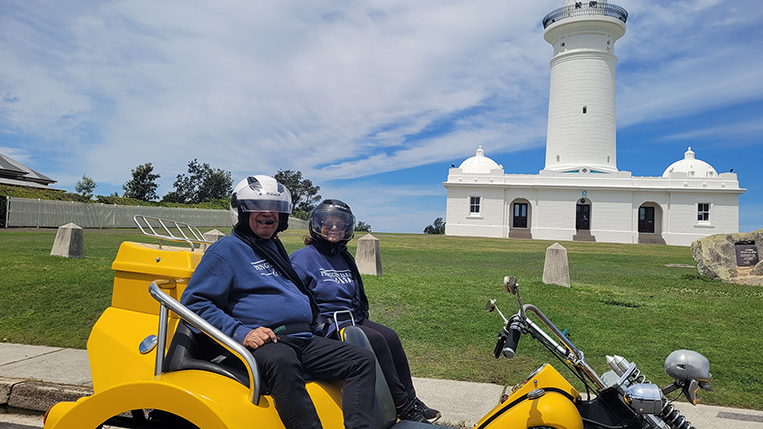
Then, they headed north and stopped at Macquarie Lightstation / lighthouse for a photo (or four). Completed in 1818, Macquarie Lighthouse was designed by convict architect Francis Greenway for Lachlan Macquarie, the Governor of NSW. Owing to crumbling foundations, it was reconstructed in the 1880s. Standing at 26 metres tall, the replacement tower was designed by the state’s Colonial Architect, James Barnet, to closely resemble Greenway’s original. It’s where this photo was taken.
The Gap
Even further north is “The Gap”. The view is towards North Head and out to the South Pacific Ocean. The Gap is an ocean cliff which faces the Tasman Sea, and is located in the suburb of Watsons Bay. Although the cliff is a popular tourist destination, it is infamous for suicides.
Gap Park is located on a coastal escarpment on Sydney Harbour’s South Head. It has spectacular views of both the harbour and the ocean. A weather worn memorial to an officer killed in the Boer War, is at the entrance to Gap Park.
Watsons Bay
Opposite is Watsons Bay. It sits on the end of the South Head peninsula and takes its name from the sheltered bay and anchorage on its western side, in Port Jackson (Sydney Harbour). Fabulous views across the harbour to the Sydney Harbour Bridge.
The detailed Sydney trike tour, now in eastern Sydney and at South Head, has shown a fun perspective to our beautiful city.
Bondi Beach
Then, they rode south to the world famous Bondi Beach. This is the beach where Bondi Lifeguards of the Bondi Rescue TV series is filmed. When in Sydney it is one of the places you should visit. The beach is seriously nice (but not our favourite) but it’s good to say you have seen it. Bondi Beach is one of the most visited tourist sites in Australia. Bondi Beach is recorded by the Australian Museum that Bondi means place where a fight using boondi sticks (nullas nullas or fighting sticks) took place.
They stopped near the Lifeguard Tower to have a look and take photos.
Oxford Street
There was enough time to ride down the famous Oxford Street. The western section of Oxford Street, which runs through the suburb of Darlinghurst, is widely recognised as Sydney’s main gay district and Oxford Street is closed to traffic once a year in early March for the Sydney Gay and Lesbian Mardi Gras.
Chinatown
Lastly, they rode to Chinatown, where they were dropped off. Sydney isn’t the only global city with a Chinatown, but this one is bigger, better and boasts more than most thanks to the Chinese immigrants who started arriving in the 1800s. Dixon Street is the main street for Chinatown, with many shops and Chinese restaurants in a pedestrian-only street. In the 1980s business owners raised funds for the ceremonial Chinese archways found at the entrance.
In conclusion, the detailed Sydney trike tour was definitely a fun, unique and memorable experience.
Feel the Freedom!
or just email trevor@trolltours.com.au and tell us what you would like to do.



 Troll Tours Pty Ltd
 Troll Tours Pty Ltd